
By Yevhen Brokhin (aka Jæk Bryö), internationally acclaimed art-tech visionary and founder of Collab, creating phygital immersive experiences.
Recently, I came across an interview with Dorothy Di Stefano, and it stopped me the way powerful art stops your breath. I’ve been following her linkedin page for almost a year. The deeper I go, the clearer it becomes: nowadays she is an absolutely stunning curator who changed the way how cities are developing.
Dorothy leads Molten.Art, the “node and nexus” connecting experiential artists across the globe. What strikes me most is how she treats art not as an object, but as a living ecosystem — a place where technology, emotion, and human presence form a single pulse.
Her work for Noor Riyadh — now a Guinness World Record holder — shows how light can rewrite a city’s night, how spectacular it is while developing cultural infrastructure.
Light as emotion. But it’s not only еmоtion. I’ll share with you an impact metrics of this project:
– +34% increase in evening public-space usage
– 27% growth in nighttime pedestrian movement
– 18% reduction in “underlit / unsafe” urban zones
– +22% rise in public-transport ridership after dark
Economic & Cultural Effects
– 3.9 million visitors in a single edition of Noor Riyadh.
– +62% revenue increase for small businesses within a 1 km radius of key sites.
– 45% of attendees were international or out-of-city visitors, making it one of the strongest cultural-tourism magnets in the region.
– Guinness World Record for the largest light-art installation ever realized.
Noor Riyadh alone brought hundreds of thousands of visitors into the city in its first edition — proof of how powerful art can be at drawing people in.
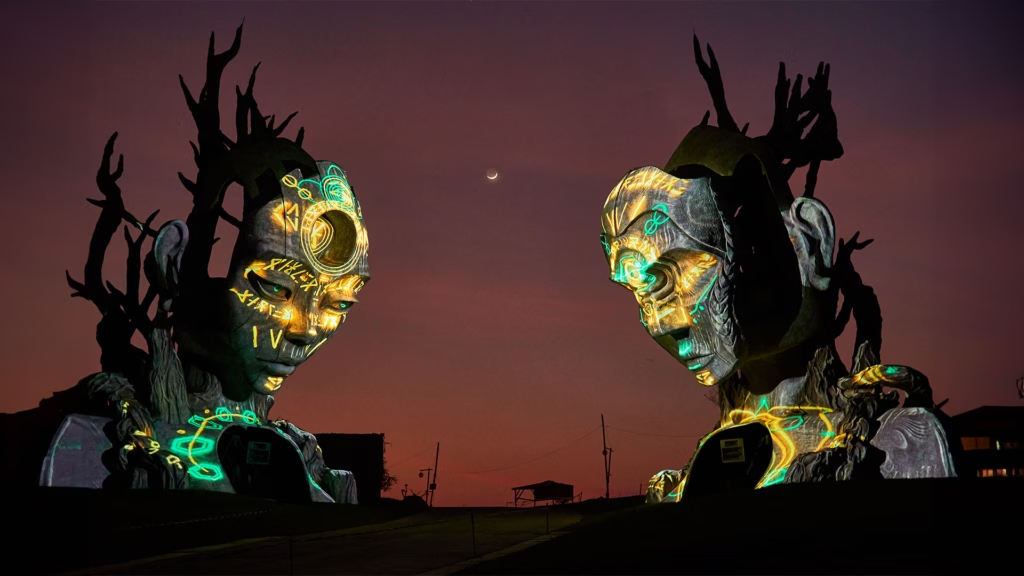
For me, one of the most compelling examples of how light and multimedia are becoming the city’s second language is Sentinels—a project created through the collaboration of COLLAB and Daniel Popper.
Project link: https://collab.wtf/works/earth-sentinels https://collab.wtf/works/earth-sentinels
This is not simply a set of sculptures. I see it as phygital infrastructure: a living system where light, sound, lasers, and projection operate as one unified language of perception, culminating each night in a multimedia choreography. In this format, art stops being an “object” and becomes a process—an event that only fully reveals itself through the viewer’s presence.
Each statue in Sentinels functions, in my mind, like a distinct node inside the urban fabric. Together, these nodes form an emotional route—an invisible path that gently shifts how people move, pause, gather, and feel within the space. This is where the project’s urban value becomes tangible: evening programming doesn’t just “decorate” the territory; it measurably extends time spent on site, intensifies nighttime pedestrian flow, and converts what used to be a transit corridor into an attraction destination. And with that comes another crucial effect I pay close attention to in city-scale work: a stronger sense of safety, created not by surveillance, but by presence, variety, and cultural vitality.
What makes this collaboration especially meaningful to me is how clearly it demonstrates a new kind of urbanism. COLLAB operates at the intersection of public art, technology, and urban development—and Daniel Popper has a rare ability to speak to people through scale, symbolism, and emotion. Together, they shaped something I would describe as a permanent immersive installation that influences basic social rhythms and builds a new cultural layer into the city itself.
This is the point I keep returning to: Sentinels shows that art does not merely illustrate space—it reprograms it.
And it also proves something I consider essential: light is not here to be decorative. Light is a tool. A means to give the city rhythm, animate nightlife, strengthen belonging, and turn places into cultural markers. As phygital art systems like this take root, I believe we are watching a new urban language being born—spoken first by the world’s most vibrant and magnetic locations.
Reading Dorothy’s reflections on nature, music, and intuition brought to mind what Olafur Eliasson once said:
“Art is not the object — it’s the experience it creates.”
Dorothy embodies that idea. In her work, immersive art stops being entertainment and becomes a way for cities to grow emotionally. You can feel this shift in major projects across the world: Bauder’s Dark Matter in Berlin, teamLab’s living ecosystems in Tokyo, Studio Drift’s kinetic poetry in Amsterdam, Refik Anadol’s data-sculptures in Los Angeles.
Each one turns public space into a sensory instrument —
and each one attracted millions of visitors , reshaping the cultural economy of their cities.
At COLLAB, we share this belief:
art is the emotional operating system of urban life. It builds cultural capital, extends dwell time, sparks community and gives cities a new rhythm.
And it leaves me with one thought:
If art can transform a street, a district, an entire city…
What could it transform next?




Leave a Comment
You must be logged in to post a comment.