
Here’s Everything They Can See — And What It Means for Your Privacy
Introduction: The Eyes on Every Corner
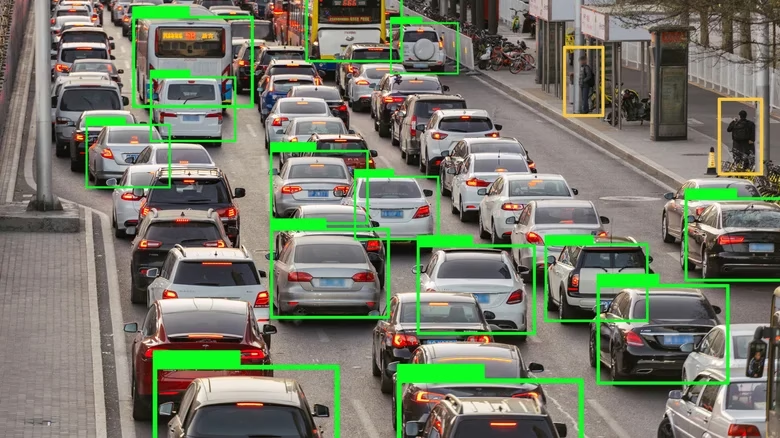
They’re mounted on poles, bridges, intersections, and highways. They never blink, never sleep, and increasingly — they never forget. AI-powered traffic cameras have quietly become one of the most expansive surveillance networks ever built, and most people have no idea how much these devices can actually see.
In 2025, more than 770 million surveillance cameras are in operation worldwide, with AI-enhanced traffic cameras making up a rapidly growing share. Cities from London to Los Angeles, Dubai to Delhi, are deploying smart camera systems that go far beyond simply photographing red-light runners.
This guide breaks down exactly what these cameras can see, how the technology works, where your data goes, and what rights — if any — you have to push back.

| Key Stat By 2026, the global smart traffic camera market is projected to exceed $12.3 billion, growing at a CAGR of 9.7%. Over 65% of new installations include AI-based analytics capabilities. |
What Are AI Traffic Cameras?
Traditional traffic cameras were passive: they captured footage, stored it, and humans reviewed it later. AI traffic cameras are fundamentally different. They process video in real time using machine learning models to detect, classify, and act on what they see — automatically.
These systems typically combine several layers of technology:
- High-resolution optical sensors (4K–16K capable)
- Onboard edge-computing chips (NVIDIA Jetson, Qualcomm AI 100, custom silicon)
- Deep learning models for object detection and classification
- Cloud connectivity for data aggregation and long-term analytics
- Integration with law enforcement, traffic management, and city databases
Everything AI Traffic Cameras Can See
🚗 License Plate Recognition (LPR / ANPR)
License Plate Recognition is the most widespread AI camera capability. Modern systems can read plates at speeds over 200 km/h, in low light, at angles up to 45 degrees, and across multiple lanes simultaneously. Accuracy rates routinely exceed 98.5%.
What this means in practice: Every time you drive past an AI camera, your plate — and therefore your identity, vehicle registration, insurance status, and travel history — can be logged, timestamped, and cross-referenced against law enforcement databases in milliseconds.
| ⚠️ Real-World Impact In the UK, the National ANPR network processes over 50 million plate reads per day. In the US, private companies like Vigilant Solutions hold databases of over 9 billion plate records. |
👤 Facial Recognition
While more controversial and less universally deployed, AI cameras with facial recognition capabilities are operational in China (extensively), parts of Europe, and select US cities. These systems can identify individuals by comparing facial geometry against watchlists or wider ID databases.
Key capabilities include: identification at distances up to 50 meters, recognition even with partial obstructions (masks, hats, glasses — with reduced accuracy), matching against driver’s license and passport photo databases, and real-time alerting when flagged individuals are detected.
🚕 Vehicle Type, Make & Behavioral Analysis
Beyond plates, AI cameras classify vehicle types (car, truck, motorcycle, bicycle, pedestrian), detect make and model, identify vehicle color, and track movement patterns. Behavioral analysis algorithms can flag erratic driving, detect vehicles running red lights or speeding, and even identify vehicles that circle a location multiple times — a tactic associated with criminal surveillance.
📱 Device Detection & Connectivity Tracking
A growing category of smart camera deployments includes WiFi and Bluetooth sensors capable of detecting the MAC addresses of mobile devices. While manufacturers claim data is anonymized, researchers have repeatedly demonstrated that MAC address tracking can be de-anonymized, allowing the movement of specific individuals to be tracked across a city.
🌡️ Behavioral & Crowd Analytics
In urban deployments, AI cameras increasingly analyze pedestrian behavior: counting crowds, detecting unusual gatherings, identifying individuals moving against traffic flow, and flagging aggressive or distressed body language. Some systems claim to predict criminal behavior before it occurs based on movement pattern analysis.
How Long Is Your Data Stored?
Data retention policies vary enormously by jurisdiction and operator. Below is a general overview:
| SEO Element | Value |
| Local Traffic Management | 24–72 hours (overwritten) |
| Law Enforcement ANPR | 1–3 years (EU); varies by US state |
| Private LPR Networks | Up to 5+ years; often no legal maximum |
| Facial Recognition Logs | Varies; often unregulated |
| Cloud AI Analytics | Depends on vendor contract; 1–10 years |
Who Has Access to This Data?
- Local and national law enforcement agencies
- Government traffic management authorities
- Private companies contracted to operate camera systems
- Insurance companies (in some jurisdictions via data-sharing agreements)
- Immigration and border control authorities
- Third-party data brokers (particularly for private LPR networks)
In the US, there are no comprehensive federal laws governing traffic camera data sharing. The result is a patchwork of state regulations, with many states allowing law enforcement agencies to share data with federal agencies, private companies, and even foreign governments with minimal oversight.
Accuracy, Bias & The Risk of False Positives
AI surveillance systems are not infallible. Academic studies have documented significant accuracy disparities in facial recognition systems, particularly for women, people with darker skin tones, and older individuals. The NIST Face Recognition Vendor Testing (FRVT) found that many commercial systems had false positive rates up to 100 times higher for certain demographic groups compared to white males.
| ❗ Critical Risk In multiple documented cases in the US, individuals were wrongfully arrested based on misidentifications by facial recognition systems integrated with traffic and public surveillance cameras. At least three wrongful arrests in Detroit and New Orleans have been publicly confirmed and resulted in lawsuits. |
Legal Landscape: What Protections Exist?
Legal frameworks around AI traffic surveillance are evolving quickly, but coverage remains inconsistent:
🇪🇺 European Union
The EU AI Act (2024) classifies real-time biometric surveillance in public spaces as ‘high-risk,’ with strict requirements and limited exceptions. The GDPR provides strong data minimization and purpose limitation principles that apply to camera data.
🇺🇸 United States
No federal framework governs AI camera surveillance specifically. Illinois’ BIPA, California’s CCPA, and municipal bans in cities like San Francisco and Boston offer patchwork protections. The majority of states have no relevant legislation.
🇬🇧 United Kingdom
The UK operates one of the world’s most extensive ANPR networks. The Surveillance Camera Code of Practice provides guidance, but enforcement is limited. A 2022 High Court ruling found certain uses of live facial recognition by police to be lawful.
How to Protect Your Privacy
While no method provides complete protection from AI traffic surveillance, the following measures can meaningfully reduce your exposure:
- Know your rights: Request data access under GDPR (EU), CCPA (California), or local equivalents
- Use privacy-respecting navigation apps that don’t share location data
- Advocate for strong local ordinances limiting camera use and data retention
- Support organizations litigating against unlawful surveillance practices
- If in a jurisdiction where legal, consider anti-camera techniques like IR LEDs near license plates (verify local legality)
- Contact elected representatives to push for federal data protection legislation
The Future: What’s Coming Next
The trajectory of AI traffic camera technology points toward even deeper integration. Within the next 3–5 years, analysts expect:
- Emotion and stress detection capabilities becoming commercially available
- Integration with smart city IoT infrastructure for real-time behavioral profiles
- Vehicle-to-infrastructure (V2X) communication enabling passive tracking of connected cars
- Gait recognition systems supplementing facial recognition where faces are obscured
- AI systems that can retroactively search historical footage based on new suspect data
📋 Frequently Asked Questions (FAQ Schema)
Q: Can AI traffic cameras see inside your car?
A: Standard installations cannot see clearly inside vehicles unless positioned overhead at a steep angle. However, some specialized systems used at checkpoints or toll booths can capture interior images at close range.
Q: Are AI traffic cameras legal everywhere?
A: The legality varies by country, state, and municipality. Most jurisdictions allow standard LPR cameras; facial recognition in public spaces faces tighter restrictions in the EU and some US cities.
Q: Can I find out if my data has been collected?
A: In jurisdictions covered by GDPR or CCPA, you have the right to request data. However, law enforcement exemptions are broad, and private LPR operators often operate with minimal transparency obligations.
Q: Do dashcams protect you from AI cameras?
A: Dashcams document your own experience but do not prevent AI cameras from recording your vehicle. However, dashcam footage can provide evidence if you’re wrongly accused based on AI misidentification.
💡 Conclusion
AI traffic cameras represent one of the most significant expansions of mass surveillance infrastructure in human history — deployed largely without public debate, democratic oversight, or robust legal frameworks. Their capabilities in 2025 extend far beyond what most people imagine, and the data they collect flows through networks most citizens never see.
Being informed is the first step. Understanding what these systems can do, who controls the data, and what legal rights you hold is essential groundwork for advocacy, policy engagement, and personal decision-making in an increasingly watched world.






Leave a Comment
You must be logged in to post a comment.