
However, before embarking on a trip off the beaten track or pulling a travel trailer, there are a few things you need to take into account besides hitching up and hitting the road. Any individual who may have an adventurous nature or wishes for an exhilarating trip should know the difference between towing capacity and payload to ensure safety, as well as the prolonged use of the vehicle. Modern body-on-frame SUVs such as the Toyota 4Runner have been able to endure tough terrains because of their robust turbocharged engines or even innovative means of delivering the engine’s power. However, exceeding the towing capacity of an SUV increases risk for safety and affects how the vehicle will perform. Tipping the scale beyond the capacity of a new toyota 4runner, for example, may negatively affect its handling and performance. Comparing a Toyota 4Runner to other midsize vehicles allows individuals to achieve a perfect balance between outdoor power and towing capabilities in everyday situations.
Weight Ratings Made Easy: Towing Capacity vs. Payload
Before you put gear in your car or hook up a trailer, you need to know how car makers figure out the highest weight your car can handle.
The big thing that sets payload apart from towing
Payload means the total weight of all people, cargo, extra parts, and the trailer tongue weight that you put inside or on the main part of the car or truck. Towing capacity is the highest total weight of a trailer and everything in it that your car or truck can pull safely behind it.
Essential Weight Terms Defined
- Curb Weight: This is the total weight of the empty car. It includes all the standard parts, a full tank of gas, and needed fluids. There are no people or extra stuff inside.
- Gross Vehicle Weight Rating (GVWR): This is the highest weight the car can have when it is full. It counts all people, their things, and the weight on the hitch.
- Gross Combined Weight Rating (GCWR): This is the maximum weight allowed for the car, plus the people, anything packed inside, and the trailer together.
- Tongue Weight: This is the weight that pushes down on the car’s hitch ball. It is usually between 10% and 15% of the trailer’s full weight.
Weight Rating Term What It Measures Impact on Off-Road Driving
Payload Capacity: Weight placed in or on the vehicle. Controls rear suspension sagging and how high the vehicle is from the ground
Towing Capacity: Total weight pulled behind the vehicle. Decides how hard the engine works, how much pressure is put on the engine and brakes
Tongue Weight: Downward force on the hitch (usually 10-15% of the trailer’s weight). Directly takes away from the total available payload
GVWR: Maximum weight that is safe for the vehicle overall. Enforces limits for frame and axle strength
Figuring Out Real Towing Limits and How Tongue Weight Affects Them
A mistake that many adventure drivers make is thinking they can tow at the maximum limit and load the cargo area with lots of heavy camping gear at the same time.
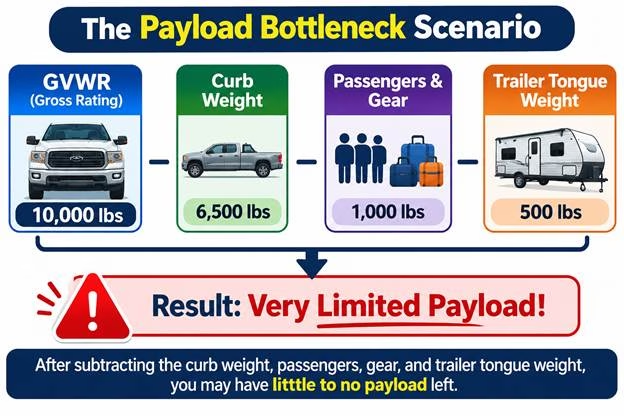
Let’s say you have an adventure SUV that can tow up to 6,000 lbs. The same SUV can carry up to 1,200 lbs in its payload.
- If you hook up a 5,000-lb travel trailer, the tongue weight at 10% will put about 500 lbs right onto the vehicle’s back axle.
- When you take that 500-lb tongue weight out of the 1,200-lb payload, you have just 700 lbs left for all the people, dogs, roof racks, armor, and anything else inside the car.
- If you go over this last 700 lbs, the vehicle goes past its GVWR, even if the trailer weight is much lower than the 6,000-lb towing max.
Pro Tip: You should weigh your car when it is packed and ready at a commercial CAT scale before you start long overland trips. Take the number you get from the scale and subtract it from the GVWR sticker on the driver-side door. This is how you find out exactly how much weight you still have room for.
How Powertrains and Off-Road Gear Change What You Can Carry
Newer midsize SUVs use strong turbo four-cylinder engines and electric motors. These help give good torque, especially when you start moving. Still, the hardware in these SUVs can change how much weight they carry in real life.
High-Torque Engines and Towing Capability
New hybrid engines, which make more than 460 lb-ft of low-end torque, help you pull heavy trailers. They also help you drive up steep hills with no trouble. At the same time, the extra weight from the hybrid packs, the electric motors, the skid plates, and the metal rock rails makes the car heavier than before.
The Off-Road Trim Trade-off
Specific dedicated off-road parts like massive shock absorbers, roof racks, in-built winches, and 33 inch tires might come in handy when navigating through trails in the Toyota 4Runner. However, this translates into reduced available payload capacity. For those thinking of getting the new Toyota 4Runner either for towing purposes or building up their own overland rig, it is vital to examine each trim carefully. Such an examination will give you the opportunity to select the best trim that will maximize either trail components or luxury without compromising on payload capacity.
Understanding the relationship between the payload rating, tongue weight, and the maximum towing capacity is important. This guarantees your safety and assurance throughout road trips and off-road adventures. Calculating all these parameters and taking into account the total weight of passengers and trailers makes your vehicle safe. You are also assured of utilizing your vehicle to the maximum irrespective of its location.



Leave a Comment
You must be logged in to post a comment.