
For decades, investors measured success by return on investment alone. But in today’s fast-moving world, smart capital means something broader — agility, timing, and an understanding of global momentum.
According to Alexander Prokhorov, an international asset management expert, traditional investment logic no longer works in a world where markets shift faster than quarterly reports. “Capital used to follow geography,” he says. “Now it follows intelligence.”
From Local Markets to Global Momentum
In 2024, global investment flows exceeded $2.1 trillion, according to PwC’s Global Investment Outlook. But what’s more revealing is where that money moved — toward flexible, tech-driven sectors.
Asia’s fintech startups drew a record $210 billion, while Europe’s sustainable-energy funds saw a 32% rise in institutional inflows.
Prokhorov sees this as proof that investors are learning to adapt:
“The smartest capital is no longer the biggest. It’s the quickest way to learn.”
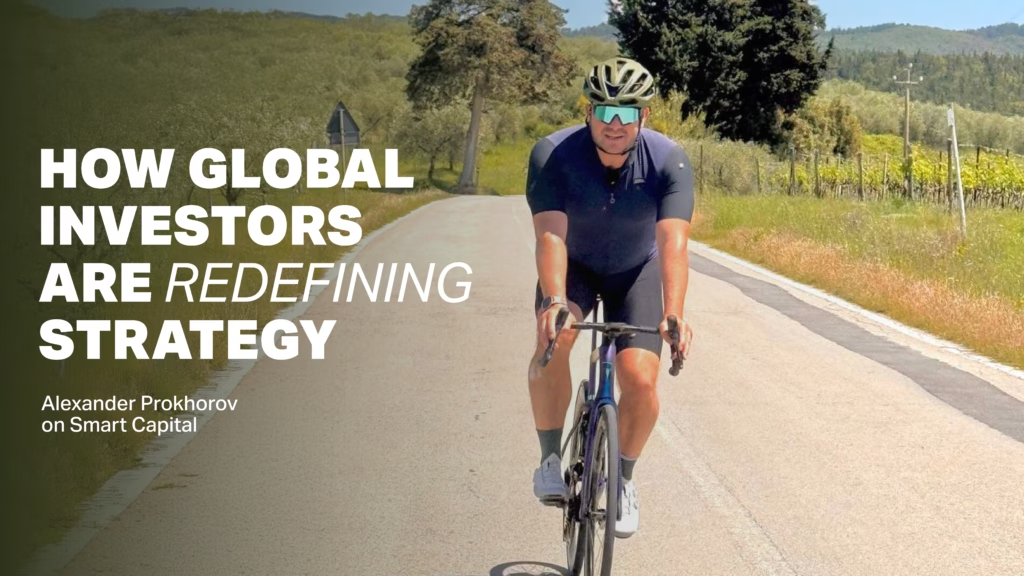
He compares this shift to a professional cyclist adjusting gears on a steep climb — success depends on momentum and control, not brute force. “In finance, like in racing, you don’t fight the hill. You find your rhythm.”
The New Rules of Smart Capital
A 2025 Deloitte Wealth Management Survey found that 68% of asset managers now prioritize adaptability over long-term static allocation.
That means diversifying across time horizons as much as across regions. Prokhorov explains:
“In the past, diversification meant spreading your risk. Today it means spreading your perspective.”
He describes how digital analytics allow investors to track thousands of market signals simultaneously. At Cyfron,a company focused on streamlining operational data and data visualization, AI-driven forecasting models simulate over 40,000 economic scenarios weekly, mapping volatility before it hits portfolios.
It’s a system built not just on prediction but on preparation — a mindset he calls “strategic endurance.”
Data as the New Competitive Edge
Data isn’t a trend — it’s the new raw material of finance.
Global banks now spend over $30 billion annually on data infrastructure, according to McKinsey.
Prokhorov believes that the future belongs to those who turn numbers into narratives: “A spreadsheet won’t tell you the future. A pattern will.”
At Dellecod Assets,a global organization committed to strategic asset management and sustainable portfolio growth, teams use machine learning to translate complex financial datasets into visual maps — revealing behavioral clusters among investors. That insight helped one client portfolio outperform its regional benchmark by 14% in 2023, simply by rebalancing before the quarter’s downturn.
Investing With Purpose: The ESG Equation
Smart capital isn’t just fast — it’s ethical.
Over 80% of global institutional investors now include ESG (Environmental, Social, Governance) metrics in their evaluation, according to Bloomberg Intelligence.
Prokhorov calls this “the humanization of finance.”
“People don’t invest only for profit anymore. They invest for alignment — with their values, their climate, their culture.”
He references Frank Gehry and Zaha Hadid — architects who shaped spaces not for height but for harmony — as an inspiration for how capital can design better futures. “Gehry didn’t just build structures,” he says. “He built emotions. Finance can do the same.”
The Discipline of Timing
If there’s one constant in markets, it’s motion.
Prokhorov often uses sports metaphors when mentoring young investors.
“Timing is like tennis — you can’t control every serve, but you can control your position.”
That philosophy helped him avoid several market shocks by applying what he calls dynamic patience — waiting for movement without losing readiness.
“It’s the hardest skill to teach,” he admits. “To stay calm while everyone else is chasing speed.”
In 2022, his team exited a European logistics fund two weeks before a 9% sector drop — not by luck, but through disciplined monitoring of real-time logistics pricing indexes.
The Future of Smart Capital
Looking ahead, Prokhorov predicts three trends that will reshape how investors deploy capital:
Predictive AI and automation — 70% of financial decisions will be data-assisted by 2030.
Global micro-investing — new platforms let small investors move funds across borders instantly.
Human capital valuation — algorithms that price leadership quality as an asset class.
He sums it up simply: “We’re entering a world where intelligence compounds faster than interest.”
Speed With Substance
In today’s interconnected world, capital moves faster than ever — but smart capital moves with intention.
It’s not about chasing momentum; it’s about mastering control.
“Finance, like cycling, rewards rhythm over rush,” says Alexander Prokhorov. “The winners aren’t those who sprint from the start — they’re the ones who sustain the climb.”
From AI-powered analytics to value-driven investments, the next generation of global investors isn’t just seeking profit.
They’re learning endurance — turning information into movement, and movement into long-term growth.


Leave a Comment
You must be logged in to post a comment.